
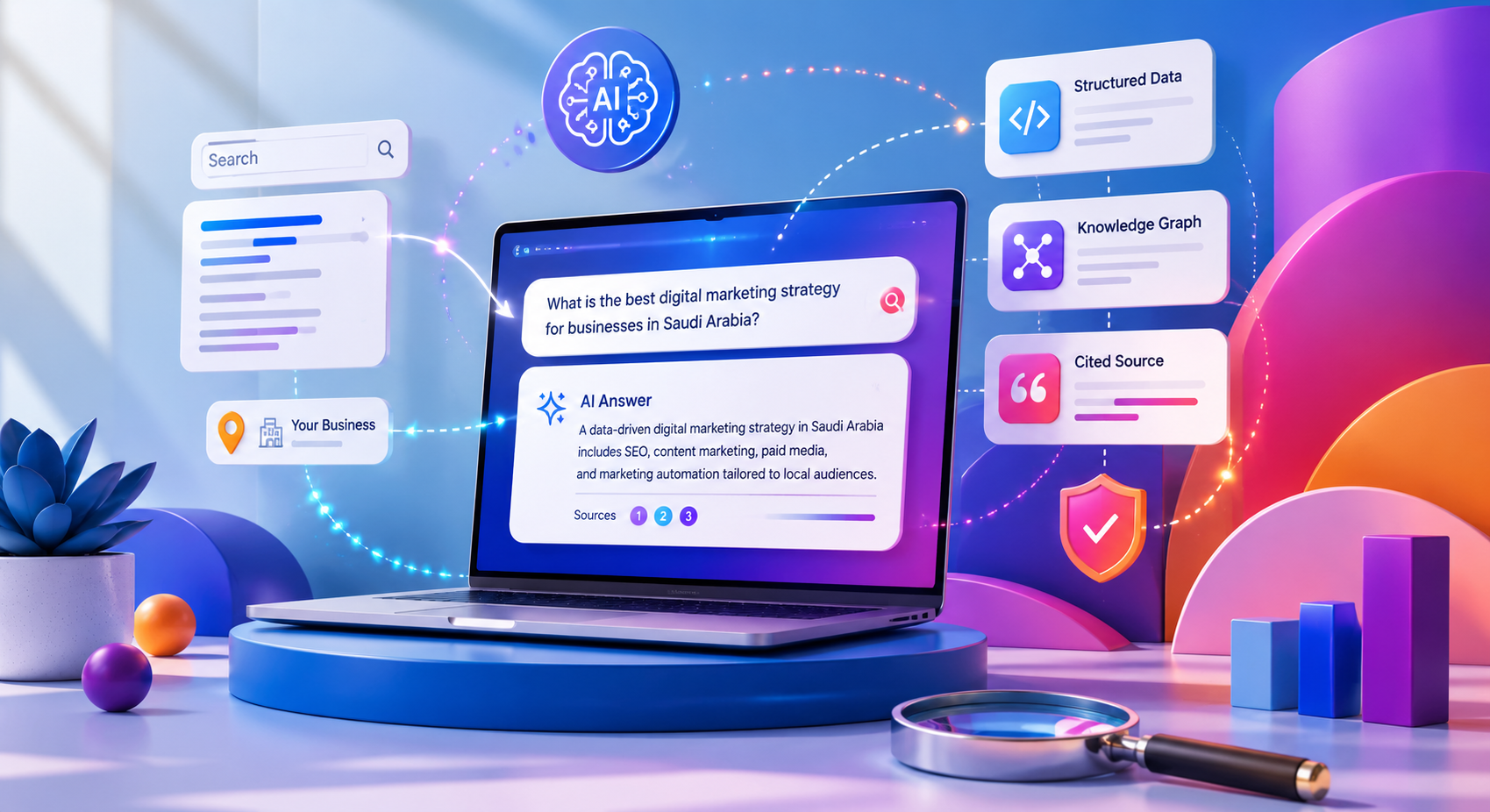
A business can rank first on Google for its most important keyword and still be functionally invisible to a growing share of its potential customers. That sounds contradictory, but it’s becoming an increasingly common reality as more people skip the list of search results entirely and ask an AI tool the question directly instead — and if that AI tool doesn’t reference the business as part of its answer, ranking #1 in the traditional sense stops mattering nearly as much as it used to.
This is the shift that AEO — AI search optimization, sometimes called answer engine optimization or generative SEO — exists to address. It’s a distinct discipline from traditional SEO, not a replacement for it, and right now almost no agency or business across Saudi Arabia and the wider GCC is actively addressing it, which creates a real opportunity for whoever starts first.
The Shift: How People Search Has Actually Changed
For roughly two decades, searching online meant typing a few keywords into Google and scanning a list of blue links to find the most relevant one. That behavior hasn’t disappeared, but it’s no longer the only way people find information, and for a growing number of queries, it isn’t even the primary way anymore.
Increasingly, people ask tools like ChatGPT, Gemini, or Google’s own AI Overviews a direct question in natural language — “what’s the best way to improve conversion rates on a Saudi e-commerce site” rather than typing “CRO Saudi Arabia” into a search bar — and the tool generates a direct answer immediately, sometimes citing sources, sometimes not, without the person ever clicking through to a website at all.
For a business, this changes what “being found online” actually means. Traditional SEO optimizes for showing up in a list a person scans and chooses from. AEO optimizes for being the source an AI system draws from, summarizes, or directly cites when it generates that answer — a fundamentally different target, even though many of the underlying principles overlap.
AEO vs. Traditional SEO — What’s Actually Different
The two disciplines share a foundation but diverge in important, practical ways.
Traditional SEO is built around ranking a page highly for specific keyword phrases, optimizing meta titles and descriptions to encourage clicks, and building backlinks and domain authority over time. The end goal is a click — getting a person from a results page onto the actual website.
AEO is built around being a source an AI system can confidently extract a clear, accurate, directly usable answer from, even if that means the person reading the AI’s answer never clicks through to the original site at all. The content’s job shifts from persuading someone to click toward being clearly correct and easy for a machine to summarize accurately.
This means content written purely for persuasion — heavy on marketing language, light on direct factual statements — tends to perform worse for AEO than content that states things plainly and clearly, even though persuasive copy often performs perfectly well for traditional conversion purposes. The two goals don’t always pull in the same direction, which is part of why this needs deliberate attention rather than assuming good SEO automatically covers it.
What Makes Content “AI-Citable”
A few practical characteristics consistently show up in content that AI systems draw from and cite, based on how these systems are currently designed to extract and summarize information.
Clear, direct answers placed early. Content that states a clear answer to a likely question near the top of a page — rather than building up to it gradually through a long narrative introduction — gives an AI system something concrete and easy to lift directly.
Structured data and schema markup. Technical markup that explicitly labels what a piece of content is (a service description, a FAQ, a how-to guide) helps AI systems understand and categorize the content correctly, beyond what they can infer from plain text alone.
Demonstrated expertise and clear authorship. Content that’s clearly attributed to a real source with relevant authority on the topic tends to be treated as more trustworthy and citable than anonymous or vague content with no clear point of origin.
Consistent factual accuracy across a site. If different pages on the same website state slightly different facts about the same thing — pricing, service details, location — that inconsistency makes a site a less reliable source for an AI system to draw from confidently, even if a human visitor might not notice the discrepancy at all.
Genuinely answering the question, not circling it. Content that takes several paragraphs of context before actually addressing the core question performs worse here than content that addresses it directly and then provides supporting context afterward.
Why This Matters Specifically for GCC Businesses Right Now
AI-assisted search adoption is growing quickly across Saudi Arabia and the broader GCC, in line with global trends, and very few businesses or agencies operating in this region have started actively optimizing for it. That gap matters because being one of the first sources an AI system learns to associate with a particular topic or service tends to compound over time, in a way that’s harder to displace later once that association is established, similar to how early backlinks and domain authority compounded for traditional SEO in its early years.
This isn’t a guaranteed advantage that lasts forever, and it would be dishonest to claim otherwise — this is a genuinely new and evolving area, and exactly how it develops over the next few years isn’t fully settled yet, even among people who study it closely. But starting now, while almost no regional competitor is paying attention to it, carries more practical weight than starting once it becomes standard practice across the industry.
A Simple Self-Audit to Start With
Before any major content overhaul, it’s worth asking a direct question about each key page on a website: if an AI tool were summarizing this page to answer a related question, could it find a clear, accurate, complete answer easily — or would it have to work hard to extract one from persuasive language, vague claims, or buried information?
Pages that fail this informal test are usually the ones worth revisiting first — not necessarily rewriting from scratch, but tightening so the core factual answer is clear and easy to find near the top, with supporting detail and persuasive framing following afterward rather than coming first.
Where to Start
AEO isn’t a replacement for the SEO work a business should already be doing — it’s an additional layer that addresses a real and growing shift in how people actually find information now. Most businesses don’t need to overhaul their entire content strategy to address it; they need a clear sense of which pages matter most and where the current content makes it unnecessarily hard for an AI system to extract a confident answer.
At ProAladdin, we help businesses across Saudi Arabia and the GCC understand where they stand on this and what’s worth prioritizing first, as part of a broader SEO and AI-readiness strategy.