
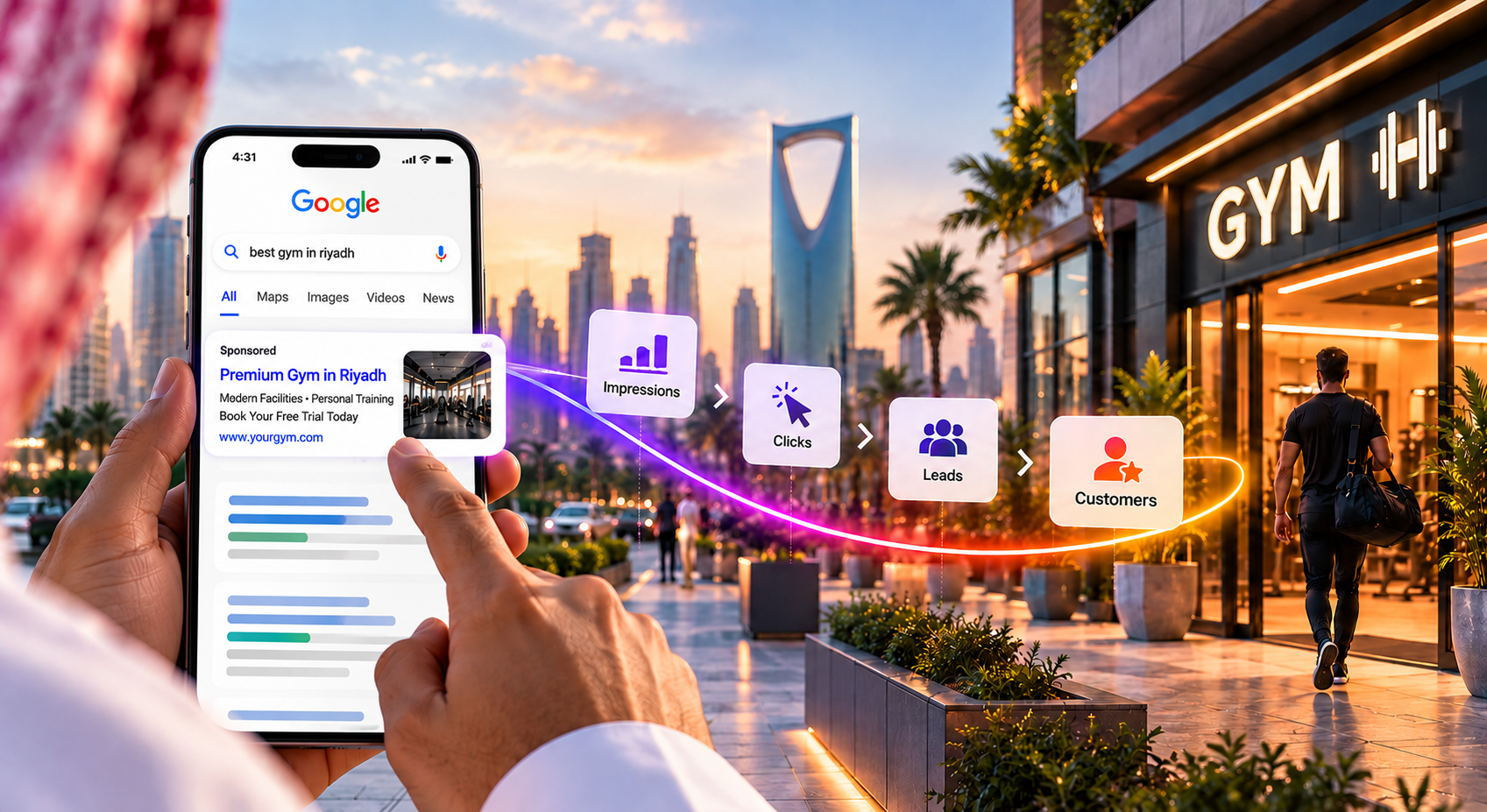
Paid advertising can put a business in front of potential customers quickly, but visibility alone is not the goal. Effective pay-per-click campaigns connect the right audience, offer, search intent, landing page, and measurement system so advertising spend supports a clear business objective.
For businesses in Saudi Arabia and the wider GCC, this means building campaigns around how customers search and make decisions in each market. A campaign targeting Riyadh may need different messaging from one targeting Jeddah, while expansion into Doha or Kuwait City may require its own targeting and commercial context.
When comparing a PPC agency in Saudi Arabia, the key question is not simply whether an agency can launch Google Ads. It is whether it can build, manage, measure, and improve paid campaigns around qualified demand and measurable business outcomes.
What PPC Advertising Services Actually Include
PPC services cover much more than creating an advertisement and selecting keywords. A complete process can include market and keyword research, campaign structure, audience targeting, ad creation, landing-page recommendations, conversion tracking, budget management, reporting, and continuous optimization.
Google Ads management is often a central part of this work. Depending on the business, campaigns may target high-intent searches, branded demand, specific products or services, or carefully defined audiences. The right structure depends on the commercial objective and the customer journey.
A PPC company should also have a clear process for deciding what to change after campaigns go live. Search terms, bids, budgets, targeting, ad variations, landing pages, and conversion signals can all influence performance. Without ongoing analysis, paid campaigns can become an expense that is difficult to evaluate rather than a managed acquisition channel.
Why PPC Can Be Valuable for Saudi and GCC Businesses
PPC can be useful when a business wants to capture existing demand rather than wait for organic visibility to develop. Someone searching for a service in Riyadh, Jeddah, Doha, or Kuwait City may already have a defined need. Paid search can create an opportunity to appear at that point of intent.
For Saudi businesses, campaign structure should reflect the market being targeted. Location, language, service availability, business hours, landing-page messaging, and the conversion being measured can all affect campaign performance.
The same principle applies when expanding across the GCC. A single campaign structure is not automatically appropriate for every market. Businesses entering Qatar or Kuwait should consider whether the offer, targeting, and messaging reflect the audience and services available there.
How to Choose a PPC Agency in Saudi Arabia
Start by defining what you want paid advertising to achieve: qualified leads, enquiries, purchases, registrations, or another measurable action. This gives you a basis for evaluating the agency’s strategy and reporting.
Ask prospective providers how they approach research and campaign structure. The discussion should cover search intent, audience targeting, account structure, ad testing, conversion tracking, landing pages, and reporting. You should understand what will be measured and why.
Transparency around optimization matters as well. PPC is not a set-and-forget activity. Campaigns need to be reviewed as search and conversion data develops. A useful agency relationship should make it clear what is being tested, what has changed, and what the data suggests doing next.
Be cautious of guarantees that focus only on clicks or impressions. Those metrics can be useful, but they do not necessarily show whether advertising is generating meaningful business results. A stronger conversation is about qualified traffic, conversions, cost efficiency, and the relationship between advertising activity and business goals.
Google Ads Management: From Setup to Continuous Optimization
Effective Google Ads management begins before the first campaign goes live. Keyword and audience research should identify searches and customer needs that are relevant to the business. Conversion tracking is also important for understanding which campaigns and ads are generating valuable actions such as leads, purchases, or sign-ups.
Ad copy should reflect search intent and the offer on the landing page. When the advertisement and page communicate a consistent message, the customer has a clearer path from search to action.
After launch, performance data becomes the basis for decisions. Search terms can reveal irrelevant traffic or new opportunities. Conversion data can show which campaigns and audiences are producing useful actions. Ad testing can identify stronger messages, while budget can be directed toward areas contributing more effectively to the defined objective.
Measurement should also connect to the actual conversion process. If a lead becomes valuable only after qualification by a sales team, reporting should eventually reflect that reality rather than treating every form submission as equally valuable.
PPC Across Riyadh, Jeddah, Doha, and Kuwait City
Location signals can help a PPC strategy reflect the market rather than treating the GCC as one uniform audience. Riyadh and Jeddah may have different priorities depending on the business. A campaign expanding into Doha or Kuwait City should similarly consider local demand and the services actually available.
This does not mean creating separate campaigns simply because a city has been named. Geographic segmentation should follow meaningful differences in demand, budget, service availability, audience, or performance. Where those differences exist, segmentation can make optimization clearer.
For businesses operating across several GCC markets, the goal is to maintain a consistent commercial strategy while giving each market enough flexibility to reflect its own search behavior and business context.
When PPC Works With Other Marketing Channels
PPC does not have to operate independently. Paid campaigns can complement SEO by capturing demand while organic visibility develops. They can also support content and conversion-rate optimization by revealing which messages and offers attract qualified users.
Marketing automation can extend the value of paid traffic after a visitor becomes a lead. Automated follow-up, CRM workflows, lead routing, and other processes can help teams respond consistently without requiring every step to be handled manually.
Not sure which paid channels fit your business? Explore our Performance Marketing services to see how paid campaigns can be structured around measurable business objectives.
For a broader view of paid acquisition in Saudi Arabia, read our Performance Marketing in Saudi Arabia guide.
If you want to connect paid acquisition with automated lead follow-up, our AI Marketing Automation approach can help map the next stage of the customer journey.
Common PPC Mistakes to Avoid
A PPC campaign can underperform even when the account is technically active. One common mistake is sending every searcher to the same generic landing page. If the advertisement promises a specific service or solution, the landing page should make that offer clear and give the visitor an obvious next step.
Another mistake is optimizing around clicks without checking what happens after the click. A campaign can attract traffic and still produce weak business results if conversion tracking is incomplete or the traffic does not match the offer. The account should therefore be reviewed alongside landing-page performance and the quality of the actions being generated.
Budgeting also needs context. There is no single PPC budget that works for every business. A sensible starting point depends on the market, search demand, competition, average customer value, conversion process, and the amount of data needed to make informed optimization decisions. The goal is to establish a measurable testing process rather than spend a fixed amount simply because it is a common industry benchmark.
A Practical PPC Management Process
A practical process begins with business objectives and conversion definitions. From there, the work moves through research, account structure, campaign creation, tracking, launch, analysis, and ongoing optimization.
At each stage, the objective should remain visible. If the goal is qualified lead generation, campaigns should be evaluated against the quality and cost of leads rather than traffic alone. If the goal is ecommerce revenue, measurement should reflect purchases and their value.
This makes PPC management an ongoing decision-making process rather than a one-time campaign setup.
Ready to Run PPC Campaigns That Actually Convert?
If you’re looking for a PPC agency in Saudi Arabia to manage campaigns around real business goals, book a call and let’s build a paid strategy across Saudi Arabia and the GCC.