
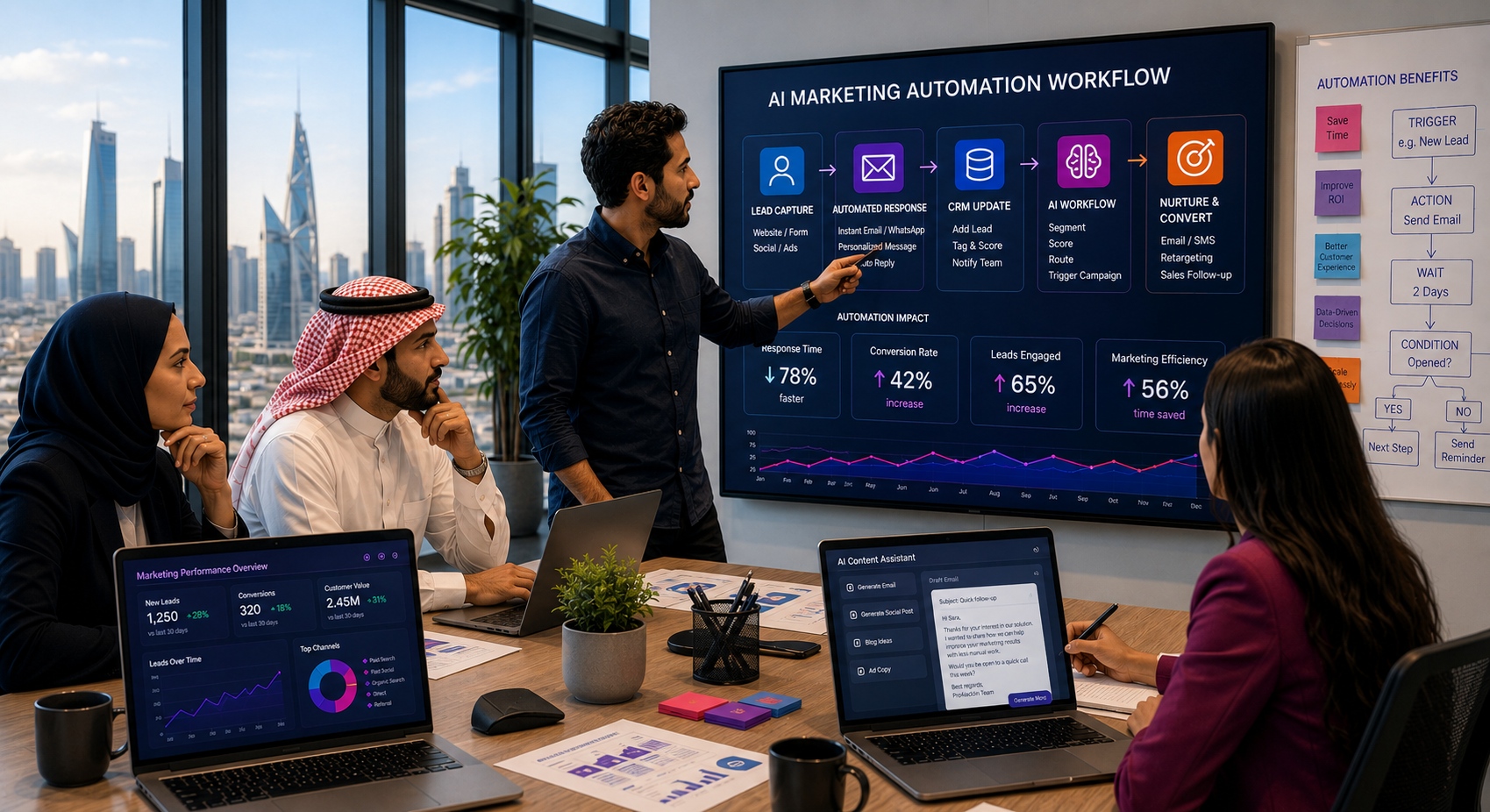
“AI marketing automation” gets thrown around constantly right now, and it usually means one of two things to the person reading it: either a vague promise that sounds expensive, or something that sounds like it will replace the marketing team entirely. Neither is accurate, and the gap between the hype and the reality is exactly where most businesses get stuck before they ever try it.
Here’s what it actually means, what it changes day to day, and where it genuinely helps businesses operating across Saudi Arabia and the wider GCC.
What AI Marketing Automation Actually Is
Strip away the buzzword and the concept is simple: AI marketing automation connects your marketing tools and customer data so that repetitive, rules-based work happens without someone manually doing it every time.
A lead fills out a form. Instead of sitting in an inbox until someone has time to follow up, an automated workflow can immediately send a personalized response, log the lead in the CRM, tag it by interest, and notify the right team member. A customer hasn’t opened the last three emails. The system can automatically adjust their journey instead of continuing to send the same campaign regardless of whether anyone is engaging with it.
None of this is about replacing strategic thinking or creative work. It’s about removing the manual, repetitive layer underneath it — the layer that, in a fast-growing business, quietly eats hours every single week without anyone tracking exactly where that time goes.
It also isn’t a single tool. It’s usually a combination of a CRM, an email or messaging platform, and a set of rules connecting them — sometimes with AI specifically handling the content generation or decision-making piece, like writing a first draft of a follow-up message or deciding which segment a lead falls into based on their behavior.
Why This Matters More in the GCC Specifically
Marketing teams in Saudi Arabia and across the GCC are often running campaigns across more operational complexity than teams in many other markets face. Bilingual content in Arabic and English isn’t optional — it’s the baseline. Multiple country-specific campaigns frequently need to run under one regional strategy. And customer journeys need to feel personal despite operating at scale across Riyadh, Jeddah, Dubai, and other markets simultaneously.
Each of those is a multiplier on manual work. A campaign that needs to run in two languages across three markets doesn’t take twice the effort manually — it takes several times the effort, because every variation needs separate tracking, separate follow-up sequences, separate timing decisions around things like Ramadan or national holidays, and separate reporting. Automation absorbs that multiplication instead of a team absorbing it through longer hours and more headcount.
There’s also a regional timing factor worth naming directly: very few agencies or in-house teams across Saudi Arabia, the UAE, and the broader GCC are positioning themselves around AI-driven marketing operations yet. That creates a window where adopting this now, while it’s still uncommon, carries more competitive weight than it will once it becomes standard practice across the region.
Real Use Cases, Not Abstractions
It helps to be specific about what this looks like in practice, because the term itself stays abstract until it’s tied to something concrete.
Automated lead follow-up. This is the single highest-impact place most businesses start. A lead that gets a response within minutes converts at meaningfully higher rates than one that waits hours — and most sales teams simply can’t move that fast manually, every time, for every single lead that comes in, especially during busy periods.
CRM-triggered campaigns. When a customer’s status changes in the CRM — they made a purchase, they went quiet for 60 days, they downloaded a specific resource, they abandoned a cart — a triggered campaign responds automatically instead of waiting for someone to notice that change and decide to act on it, which in practice often just doesn’t happen at scale.
AI-assisted content production. Drafting first versions of social posts, email sequences, or ad copy variations faster, so the marketing team’s time goes into refining and approving rather than starting from a blank page every single time a new piece of content is needed.
Automated reporting. Pulling performance data from ad platforms, the website, and the CRM into one regular, consistent report instead of someone manually exporting and compiling spreadsheets every week — a task that adds up to real hours over a quarter with very little strategic value attached to doing it manually.
Lead scoring and segmentation. Automatically ranking leads by how likely they are to convert based on their behavior, so sales effort goes toward the leads most worth pursuing first instead of working through a list in the order it arrived.
What to Automate First
Not every part of a marketing operation should be automated at once, and trying to automate everything immediately is one of the more common ways businesses end up with a system nobody trusts or uses properly — because when something breaks in an overly complex system, it’s hard to tell where, and people quietly go back to doing things manually anyway.
The lowest-risk, highest-value starting points are usually:
- Lead response time — because delay here has a direct, measurable cost in lost conversions, and the fix is relatively simple to implement
- Internal reporting — because it’s purely operational with no customer-facing risk if something needs adjusting
- Re-engagement sequences for inactive contacts — because the realistic alternative is usually doing nothing with those contacts at all, so there’s very little downside to trying
Each of these can be implemented, measured, and adjusted before moving to anything more customer-sensitive, like full automated nurture journeys across a customer’s entire lifecycle.
Where Human Judgment Still Matters
It’s worth being direct about this: automation handles repetition well and judgment poorly. Brand voice, strategic positioning, how a business responds to a sensitive customer situation, and the creative direction behind a campaign all still need a person making the call. An automated system can draft a response, but deciding how a business should handle an unhappy customer publicly on social media, for instance, is not something to hand over to a rules-based workflow.
The goal isn’t a marketing operation that runs itself. It’s a marketing team that spends its time on the decisions that actually require a person, instead of the repetitive work that doesn’t.
Where to Start
The businesses that get the most out of marketing automation tend to start with one workflow, prove it works, measure the actual impact, and expand from there — not with a full system overhaul on day one that’s hard to evaluate and harder to unwind if parts of it don’t work as expected.
At ProAladdin, we work with businesses across Saudi Arabia and the GCC to identify which part of their marketing operation has the most to gain from automation, and build it from there with a clear way to measure whether it’s actually working. If you’re not sure where that starting point would be for your business, that’s exactly the conversation worth having first.