
Software that works perfectly in a demo can still fail the moment real customers start using it. A form that submits on the developer’s screen but breaks on an older phone. A checkout that works in English but misaligns in Arabic. A page that loads instantly in the office but stalls on mobile data. These gaps are rarely caught by the people who built the software — which is exactly why testing exists as its own discipline.
For businesses launching websites, mobile apps, or custom systems, software testing services in Saudi Arabia are what stand between a product that looks finished and one that actually holds up under real use. This guide explains what software testing covers, the main types, and how to choose a testing partner that protects both your product and your reputation.
What Software Testing Services in Saudi Arabia Actually Cover
Software testing is the structured process of checking that an application does what it is supposed to do — and behaves sensibly when something unexpected happens. It is not a single step at the end of a project, and it is not just “clicking around to see if it works.”
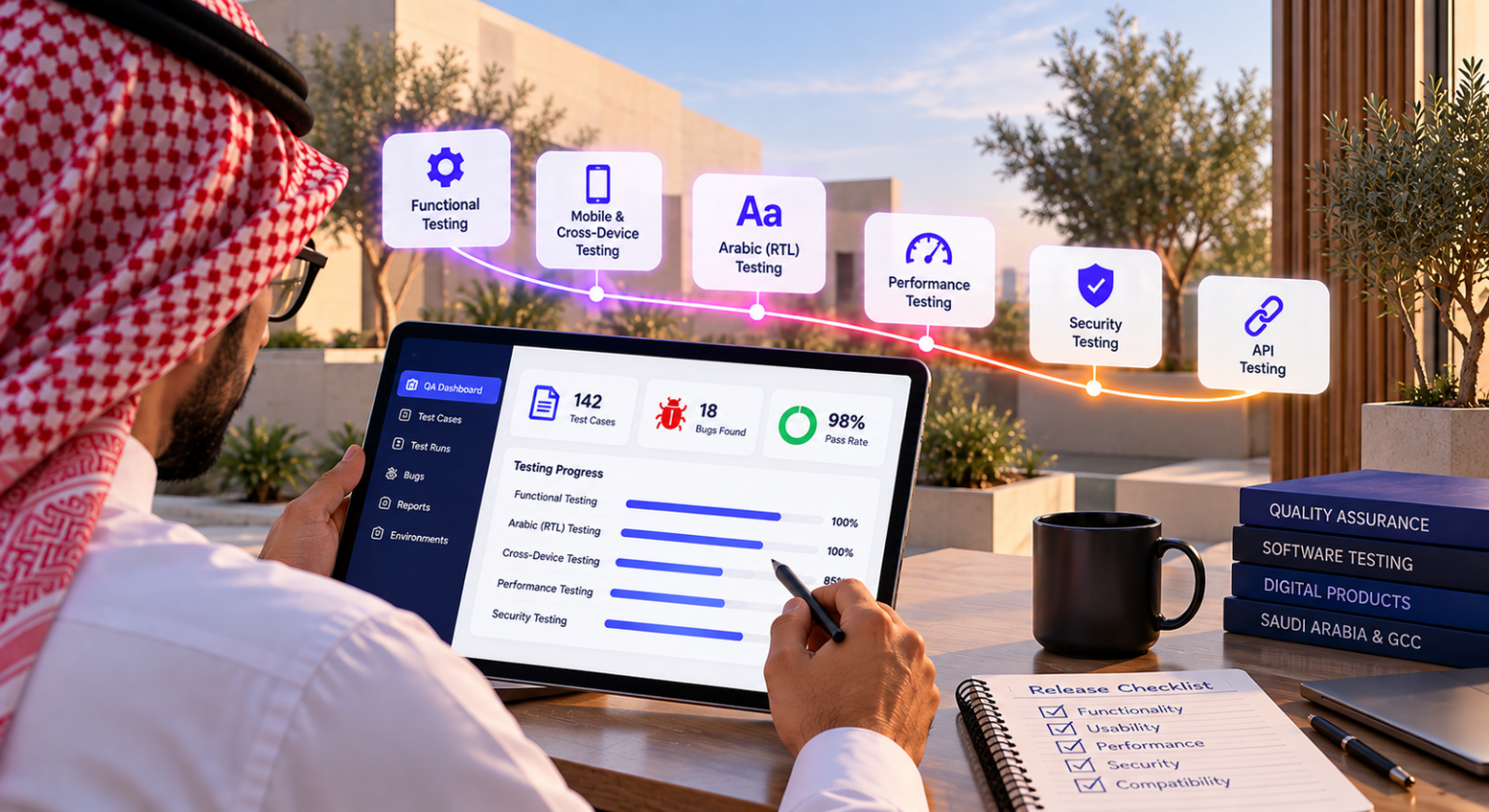
A complete process can include functional testing (does each feature do what it should), performance testing (does it stay fast and stable under load), compatibility testing (does it work across browsers, devices, and screen sizes), usability checks (can a real person actually complete the task), and user acceptance testing (does it meet what the business actually asked for).
The goal is not to prove the software is perfect. It is to find the problems before customers do, while they are still cheap and quick to fix.
Many of these practices follow internationally recognized software testing standards, such as those maintained by the ISTQB.
Why Testing Matters More for Saudi and GCC Businesses
Some testing challenges show up more often in this region specifically, and they are easy to miss when testing is treated as an afterthought.
The first is Arabic and right-to-left (RTL) support. A product built in English and then translated often develops layout problems in Arabic — misaligned forms, overlapping buttons, phone-number fields that render incorrectly, or text that breaks awkwardly. These issues rarely appear in the English version, so they slip through unless someone tests the Arabic experience directly.
The second is mobile. Mobile usage in Saudi Arabia is among the highest in the world, so a product that works well on a desktop but stumbles on a mid-range phone or on mobile data is failing the majority of its users. Testing on real devices under real conditions — not just a resized browser window — matters more here than in many other markets. This is one reason a professionally developed website should never be considered finished until it has been tested the way customers will actually use it.
The third is bilingual, multi-market operation. A business serving Riyadh, Jeddah, Doha, and Kuwait City may run the same product across languages and markets, and each combination is a place something can quietly break. Testing that only covers one language or one market leaves the rest to chance.
The Main Types of Software Testing
Different problems need different kinds of testing, and a serious partner should be able to explain which ones your product actually needs.
Functional testing confirms features behave correctly — forms submit, payments process, logins work. Performance testing checks speed and stability under realistic load, which matters for anything expecting traffic spikes. Mobile app testing verifies behavior across devices, operating systems, and network conditions. API testing checks the connections between systems, where many failures originate even when the visible interface looks fine. And user acceptance testing (UAT) confirms the finished product matches what the business actually needed, not just what was written in an early specification.
Not every project needs all of these. The right mix depends on what the software does, who uses it, and what the cost of failure is.
Manual vs Automated Testing
Both have a place, and the honest answer is that most products benefit from a combination rather than one or the other.
Manual testing is where a person uses the software the way a real customer would, looking for problems that are hard to predict in advance — confusing flows, awkward wording, or issues that only surface through genuine human use. Automated testing uses scripts to run checks repeatedly and quickly, which is valuable for repetitive scenarios and for catching problems that reappear after a change. It saves significant time on large or frequently updated products, but it takes effort to set up and maintain, so it makes most sense once a product is stable enough to be worth the investment.
A partner who insists everything must be automated, or dismisses automation entirely, is usually selling a preference rather than solving your actual problem.
When Testing Should Happen
One of the most expensive mistakes is treating testing as a final gate — a single check right before launch. By then, problems are baked deep into the product and costly to unwind.
Testing works better woven through development: checking features as they are built, catching issues early, and running a thorough round before release rather than discovering everything at once at the end. This connects directly to how the product is built in the first place, which is why testing and software development work best as parts of the same process rather than separate stages handed between teams.
How to Choose a Software Testing Partner in Saudi Arabia
Because quality varies widely, choosing well matters.
Ask how a provider decides what to test. A thoughtful partner starts from how the product is actually used and where failure would hurt most, not from a generic checklist applied to every project identically. Ask whether they test the Arabic and mobile experience directly, because in this region those are exactly where problems hide. Ask how they report issues — clear, reproducible reports a developer can act on are far more useful than a vague list of complaints.
Be cautious of anyone who promises “bug-free” software. No responsible tester can guarantee that, because no meaningful software is ever provably perfect. What a good partner can promise is a structured process that finds the problems that matter most before your customers do. You can see how we approach this in our software testing and QA services.
Testing Across Saudi Arabia and the GCC
Businesses operating across Riyadh, Jeddah, Doha, Kuwait City, and other markets often run the same product in several contexts at once. A testing approach should account for that rather than assuming one environment represents all of them. Language, local payment methods, device preferences, and network conditions can all differ enough that working in one market is not proof it works everywhere.
The practical goal is consistent quality across every market a business serves, so a customer in one city has the same reliable experience as a customer in another.
This is why software testing services in Saudi Arabia should account for every market a business serves, not just the one it tests in first.
Start With What Matters Most
You do not need to test everything exhaustively on day one. The most practical starting point is identifying where failure would cost the most — the checkout, the lead form, the core feature customers rely on — and making sure those are solid first. A product that earns traffic but loses users to broken steps has a quality problem that sits very close to a conversion problem.
From there, testing becomes an ongoing part of building and maintaining software, not a one-time event. Products change, new features ship, and each change is a chance for something to break — which is why testing continues for as long as the software is in use.
Treated this way, software testing services in Saudi Arabia become an ongoing safeguard rather than a one-time cost.
Ready to Launch Software You Can Trust?
Ready to launch software your customers can rely on?
Book a Call and we’ll help you identify where testing will protect your product and your reputation most — across Saudi Arabia and the GCC.